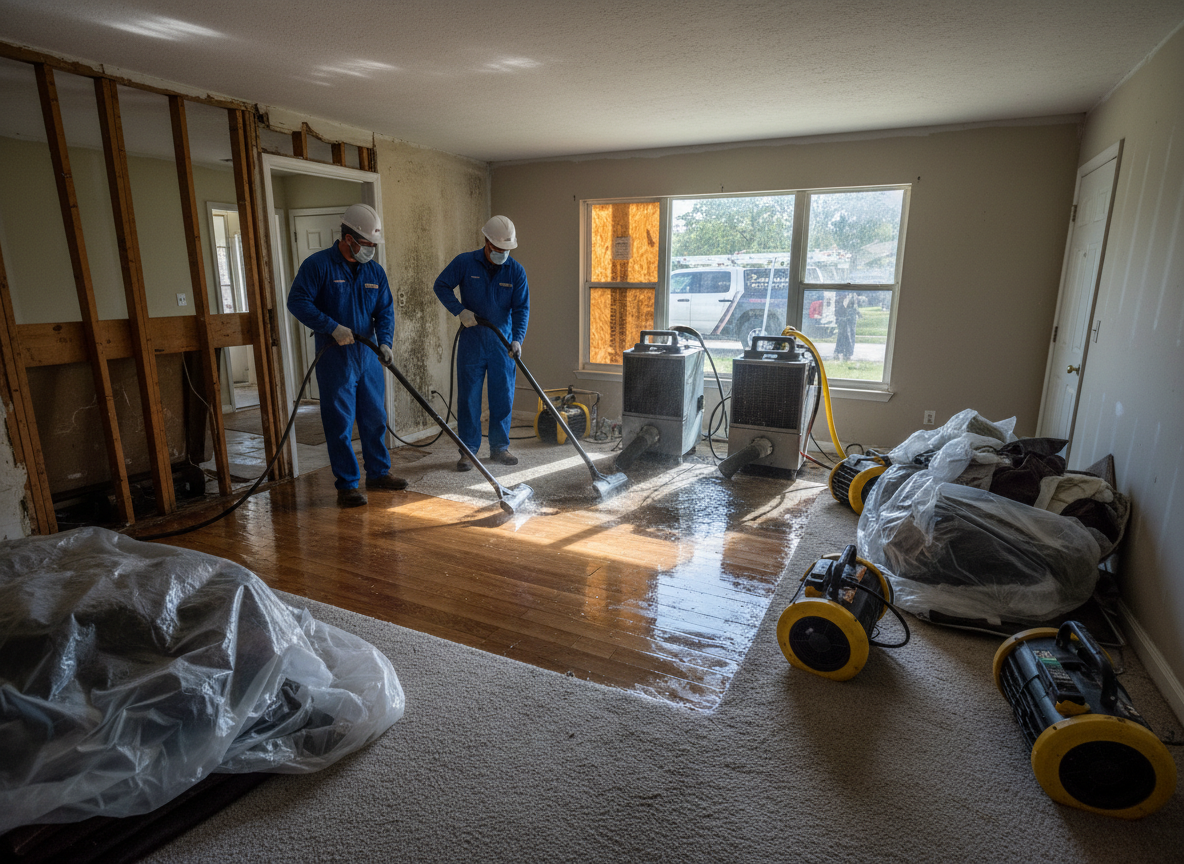
Estero is a village of gated communities and golf courses built beside an estuary, and that combination decides most of its water problems. A summer storm fills the ponds and swales, the ground is already saturated, and water backs into a lanai or crosses a slider before anyone sees it. In the older pockets the entry point is a window or a roof edge; in the newer communities it is often irrigation, a pond outfall or a door track. Either way, the water ends up in the same place: a wall base, a cabinet or a slab edge that stays damp.
What makes water damage in Estero different?
Estero is an incorporated village in Lee County with 36,939 residents (2020 census), sitting beside Estero Bay and the estuary that gives it its name. It is a young municipality, incorporated at the end of 2014, with a housing stock that ranges from older pockets to large gated communities.
The Estero River, Estero Bay and storm surge
Estero sits beside Estero Bay, the first aquatic nature preserve established in Florida, and the Estero River runs through the community toward the bay. That geography means water can arrive from the river, from the bay or from rain that cannot drain because the ground is already full. During a named storm, surge is the coastal risk; during an ordinary summer system, it is rain and saturated ground. Hurricane Ian made landfall in Lee County in September 2022 and pushed water through low-lying coastal communities around the bay. We ask which side of the village a house sits on before we assess the entry point.
A village incorporated in 2014, with housing from several decades
Estero became a village on 31 December 2014, after decades as an unincorporated community. Its housing reflects that longer history: older homes near the river and the Tamiami Trail corridor, and large gated communities built around golf courses and preserves. The village has 11 golf courses within its borders and about 35 gated communities, and Florida Gulf Coast University borders the village limits. A 1970s house and a 2010s house hold water differently, so we read the assembly rather than the address.
Flat ground, sandy soil and a preserve that sets the drainage
Much of Estero is flat and sandy, and the bay and the preserve are the receiving water for the surrounding land. When the ground is saturated and the bay is high, rain has nowhere to go quickly. That is why a storm can leave water in a lanai, a garage or a wall base even where no pipe failed. The newer communities rely on ponds and swales to hold rain, and those systems work until they are full. A pond that stays high after the storm is a sign the outfall is restricted, not that the house is dry.
Who serves Estero
The Village of Estero is the local government, so planning and building permits for most work inside the village go through the village rather than Lee County. Some services and regional drainage questions still involve the county. Many neighborhoods are gated and association-managed, which affects access and work hours. The village is also home to Hertz Arena and close to Southwest Florida International Airport, which is less than five miles north, so the housing stock includes a large share of newer, tightly built homes.
What does an Estero home need?
Most Estero losses begin at the envelope or the irrigation line, not at a fixture. Find the outside entry before touching finishes, then decide whether the job is storm work, water removal or mold remediation.
When a pond overtops or a slider track fails during a summer system, water damage restoration covers the storm phase, leak detection and extraction. In the gated communities off Corkscrew Road and Estero Parkway the entry is usually a lanai tie-in, a slider sill or a stucco crack above the band; nearer the river it is the wall base. We trace which one before cutting anything.
Standing water in a garage, a lanai or a carpeted bedroom is water removal. Estero's slab-on-grade houses hold water under tile and in cabinet toe kicks, and the ponds keep the slab cool, so the floor can feel dry while the adhesive is still wet. Extraction and drying are signed off on readings at the slab, the baseboard and the cabinet base.
A musty closet or a dark line along a baseboard is mold remediation. In a tight, air-conditioned villa, growth often starts behind the finish where a wall stayed damp after the storm passed. Containment keeps the work from spreading spores into the neighbouring rooms, and the moisture source is corrected before reconstruction.
Village work often overlaps with Three Oaks, San Carlos Park and Fort Myers Beach, each within about ten miles; the housing changes but the estuary weather does not.
Why use us in Estero?
Because the entry point in Estero is usually outside the house, and a village address brings its own rules. We read the lanai tie-in, the slider sill and the irrigation stub before proposing removal, and we separate drying from the landscape, plumbing or roofing repair that belongs to another trade. Permits inside the village go to the Village of Estero, and gated access goes through the association, so we settle both before equipment arrives. The readings and the scope are written down, and we do not publish credentials or reviews this business has not supplied.
Why Estero water damage gets worse quickly
Estero sits between the river and the bay, and the ground is flat and sandy. When a summer storm fills the ponds, water has nowhere to go until the outfall catches up, and the soil stays saturated for days. Inside, air conditioning keeps the walls cool; a damp cavity behind a slider or a lanai tie-in then sits at the dew point through the afternoon, and growth can begin in about a day or two.
The village's building pattern adds a second clock. Many homes are in gated communities where one pond serves dozens of lots, so the water table under a house can stay high long after the rain stops. A door track that leaked in August is still holding moisture in October, and a cabinet base that took water during the storm is still closed up. Waiting turns a dryable wall into a removal, and in a shared-wall villa it means coordinating the association twice.
How an Estero job runs, step by step
- Gate and scope. Tell us the community, the property manager and where the water appeared, so access is settled before a truck is loaded.
- Read from the outside in. We check the lanai tie-in, slider sill, irrigation stub and wall base, then scan the interior cavity with thermal imaging.
- Contain the unit. In a villa or condominium, containment goes up at the unit boundary and the association is told which shared wall is being read.
- Extract and dry to readings. Standing water comes out, saturated pad and cabinet base are removed where needed, and equipment runs until the marked points reach a dry standard.
- Verify and hand off. Final readings are compared with day one, and the record names the landscape, roofing or association repair that belongs elsewhere.
What's included in an Estero job
- A gate and access note naming the property manager and work hours
- A moisture survey of lanai tie-ins, slider sills, irrigation stubs and wall bases
- Thermal imaging of the cavity behind the finish
- Extraction and removal of saturated pad, cabinet base or drywall
- Containment at the unit boundary in attached homes
- Drying equipment positioned against marked readings
- A written before-and-after record for the owner and the association
What gated access changes in Estero
In Estero the water is often found before the gate is, and the gate is where a job can lose a day. About 35 gated communities sit inside the village, many with their own access rules, work hours and vendor lists, so the first practical question is who approves entry and when equipment can be brought through.
A water loss does not wait for a board approval, but the drying equipment has to sit inside the unit for days. In a gated community, that means a gate code or a vendor authorization that lasts the whole job, not just the first visit. It also means the route matters: a loaded truck, a dehumidifier and a containment frame may not fit the pedestrian gate, and some associations restrict work to certain hours. We ask for the property manager's contact and the access rule on the first call so the equipment is not turned away at the gate.
Inside the unit, the housing stock decides the scope. The village has 11 golf courses and a large share of homes built around them, so lanai tie-ins, slider tracks and irrigation stubs are common entry points, and many of those homes share a wall with a neighbor. In a villa or a condominium, the wall that is wet may belong to the association rather than the owner, and the repair may be split. We name that boundary in writing before work starts.
The Village of Estero handles building permits for work inside the village, and Florida Gulf Coast University borders the limits to the north. Neither fact changes the drying method, but both shape who signs off on the rebuild.
What should you do next?
Call (239) 499-1170 and tell us where the water is, whether the home is in a gated community and who manages access. Give us the property manager's name if you have it. If the water is near an outlet or the panel, leave the room. We cover the Village of Estero from 8710 Alico Rd in south Fort Myers.
Around Estero
We regularly work near:
- 📍Koreshan State Historic Site
- 📍Estero Bay Aquatic Preserve
- 📍Hertz Arena
- 📍Estero River
Mold Remediation in Estero — Local Notes
- •Incorporated village since 31 December 2014.
- •Estero Bay Aquatic Preserve borders the community.
- •About 35 gated communities and 11 golf courses sit within the village.
- •Southwest Florida International Airport is less than five miles north.