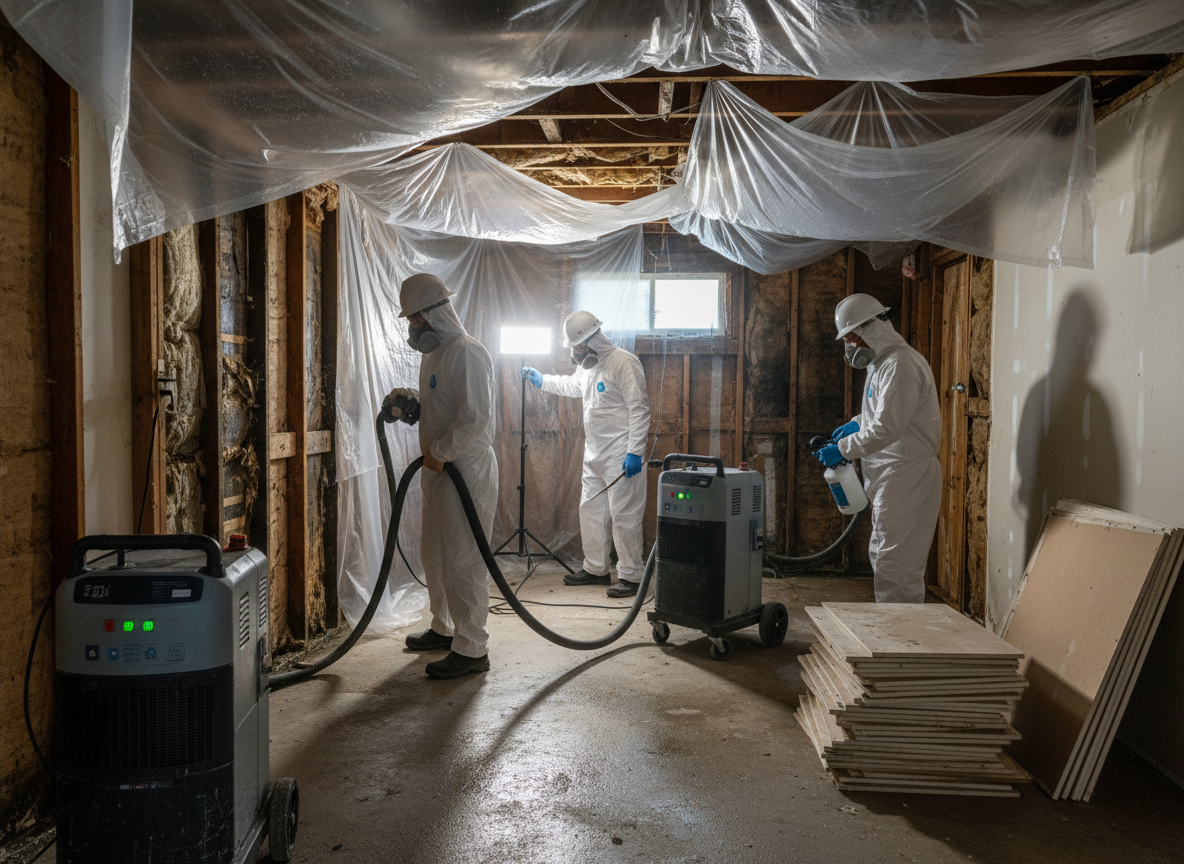
A musty smell in a Fort Myers house is easy to explain away in a climate where the air conditioning runs most of the year. The closet behind the bathroom, the wall base under a sliding door, the ceiling below an air handler: each can stay damp for weeks without showing more than a faint tide line. The growth is the visible part of a moisture problem that has been running quietly, often in a cavity nobody has read with a meter. Mold remediation only holds when that moisture is found and corrected.
Why Fort Myers owners call us for mold work
Mold work fails for predictable reasons: the moisture source is never found, containment is skipped, or the job is called finished because a wall looks clean. Those are the points we build the job around.
The moisture source is the job. Treating a wall while the leak, the condensate line or the wall base is still wet only resets the clock. The first visit finds where the water is coming from and whether it is still arriving, then separates the repair that belongs to a plumber, a roofer or the building.
Containment protects the rest of the house. A contaminated surface disturbed without containment sends spores into rooms that were never wet. Doorways are sealed, HEPA filtration holds the work area under negative pressure, and porous material is bagged out rather than dragged through the house.
Why mold work in Fort Myers cannot wait for a dry week
A mold job is a moisture job with a contamination layer on top. The growth you can see is the colony; the problem is the water that fed it and the spores already sitting in the cavity, the closet or the air path. Neither goes away because a surface was wiped.
Spore release is the part owners underestimate. Dry brushing or a household spray on a contaminated wall base lifts spores into the air and moves them into rooms that were clean, which is why the work area is sealed and held under negative pressure before anything is disturbed. Removing porous material is often the only way to take the reservoir out rather than spread it.
The climate shortens the window. Warm air, a cool interior face and a cavity that stayed damp after a storm or a plumbing leak are enough; visible growth can follow in about a day or two, and a colony that has had weeks is a different scope from one caught early. The source is corrected first, then containment, then removal and cleaning. If the source is still running, no amount of cleaning holds.
What you can check before you book mold remediation
The address in the footer is the one we work from: 8710 Alico Rd, Fort Myers, FL 33912, in Lee County. The number that reaches it is (239) 499-1170. There is no second location and no call centre.
This page covers mold remediation only. The other two offers are water removal, which takes standing water and saturated material out, and water damage restoration, which combines water extraction, water leak detection and repair, and storm damage work. If your problem falls outside those three, we will say so instead of stretching a description to fit.
Eight communities make up the rest of the service area: San Carlos Park, Three Oaks, Estero, Cypress Lake, Gateway, McGregor, Fort Myers Beach and Cape Coral, each within about ten miles. The housing differs enough that the same leak reads differently: a canal city, a barrier island, a riverfront and inland suburbs.
Nothing is claimed here that the business has not supplied. That means no licence number, no certification, no insurance certificate, no founding year, no staff biographies, no project count and no customer reviews. An air sample is not presented as proof of our own work either; independent clearance testing is a separate specialist service, and the call is where we say plainly what we can and cannot do.
A 1950s McGregor bungalow where a bathroom retile trapped the wall
McGregor Boulevard runs along the tidal Caloosahatchee, and some of the houses along it were built in the 1950s, when Fort Myers was a much smaller city. A typical bungalow from that era has concrete block or wood frame, plaster on wood lath inside, terrazzo or tile floors, and a bathroom that was originally vented by a window rather than a fan. None of that is a defect. It is simply a different assembly from a 1990s house, and it holds water differently.
A call from a house like this often starts with a smell in a hallway or a dark line along the base of the bathroom wall. The owner has had the bathroom retiled, or a shower pan replaced, and believes the leak is over. What the meter shows is different: the wall base is still holding moisture, the plaster is cool to the touch and the cavity behind the tile is wet. In a 1950s assembly there is no modern vapour barrier and often no cavity ventilation. Water that enters at a shower pan, a supply line or a window head can sit against the lath for months.
The first difference from a newer house is that plaster and lath cannot be treated like drywall. Cutting an inspection opening is possible, but the repair that follows is a plaster repair, not a drywall patch, and the owner needs to know that before anyone opens the wall. The second is that the bathroom may have been retiled over a substrate that trapped moisture. Cement board is not waterproof at the joints unless the waterproofing is continuous, and a pan that weeps for a year can saturate the framing without showing a stain on the finished side.
We read the wall base, the shower pan and the ceiling plane with a meter and a thermal camera, and we trace the moisture back to the entry point before proposing removal. Where the source is a plumbing or pan failure, we document it and name the trade that owns the repair. Where the growth is on plaster that can be cleaned and the lath behind it can be dried, we dry it rather than demolish a piece of the city's older housing. Where the lath is saturated and the plaster has let go, removal is the honest answer, and the scope says so.
Where mold in Fort Myers usually starts
Four locations account for most of the growth we are called to. Each is a moisture trap rather than a cleaning failure, and each one needs the water corrected before the growth is removed.
A bathroom exhaust that vents into the attic
The component is the exhaust fan, its duct, the roof or wall termination and the backdraft damper. A fan that moves air into the attic, into a soffit void or into a length of flex duct that has come loose is worse than no fan, because it delivers warm, wet air into a dark, still space. Some older Fort Myers bathrooms have no duct at all. What you notice is peeling paint above the shower, a musty smell that clears when the window is open, or dark speckling at the ceiling edge. The first move is to confirm where the duct actually terminates, not where it is supposed to, and stop using the fan until it is corrected.
The wall base below a sliding door or window
The component is the door or window sill, the track, the weep holes and the wall assembly below the opening. Wind-driven rain and irrigation both reach this area, and the wall base stays damp because it is the lowest, least ventilated part of the wall. In older construction the interior may be furring over block with a small cavity where water collects. What you notice is a swollen baseboard, paint lifting at the corner, a dark line along the bottom of the drywall or a smell that is strongest near the floor. The first move is to check the track drainage and the exterior sealant, then read the wall base from the interior.
A ceiling cavity after a roof or upstairs leak
The component is the ceiling plane, the drywall, the insulation above it and the joist or slab that carries the water from the source. Water entering from a roof opening, a balcony above or a neighbouring unit travels along the joist or the slab soffit before it stains a ceiling, so the visible patch is rarely directly under the leak. What you notice is a ring that grows after each rain or each shower, a soft spot when you press the ceiling or a smell in the room that gets stronger when the door is closed. The first move is to photograph the stain, keep weight off the ceiling and get the cavity read before anyone cuts.
The air-handler closet and its paper-faced drywall
The component is the air handler, the platform it sits on, the closet walls and the return-air path. The closet is often built with the same paper-faced drywall as the rest of the house, and that paper is the first material to absorb a slow condensate leak. What you notice is a musty smell at the return grille, a dark line along the closet baseboard or a rust ring on the platform. The first move is to switch the system off, empty the pan and check the float switch and drain. Cleaning the closet without correcting the drain produces a repeat within a season.
How a mold remediation job runs, step by step
- Call and history. We ask where the smell or growth is, when it started and what water event came before it. Storm history and any recent repair matter.
- Moisture and extent assessment. We read the affected area and the surrounding assembly, scan concealed areas with thermal imaging and define the boundary of the work.
- Containment and filtration. Doorways and openings are sealed, HEPA filtration is set with the work area under negative pressure, and contents are protected.
- Removal and cleaning. Affected porous material is removed and bagged out, hard surfaces are cleaned, and the cavity is dried before it is closed.
- Source correction and hand-back. We correct what is inside our scope, name the trade that owns the rest, and leave a written record of readings and material removed.
What's included in mold remediation
- A moisture assessment of the affected area and the assembly around it
- Thermal imaging where growth or moisture is concealed
- Containment of the work area with sealed openings and protected contents
- HEPA filtration with the work area under negative pressure where growth is disturbed
- Removal and bagged disposal of affected drywall, insulation and other porous material
- Cleaning of hard surfaces left behind, with the cavity dried before it is closed
- Identification of the moisture source, with the correction we can make and the hand-off we cannot
- A written record of what was found, removed and read at the end of the work