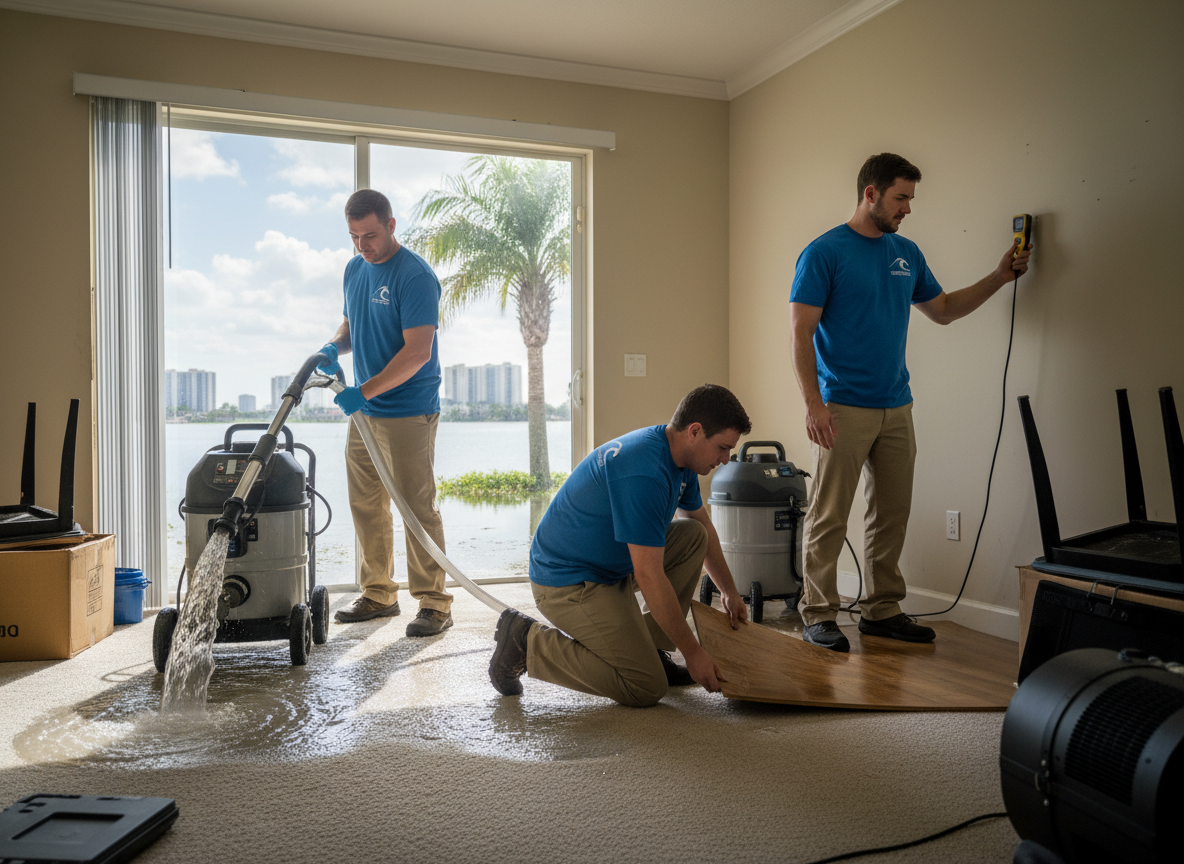
Fort Myers Beach is a barrier island, and water here does not need a plumbing failure to get into a building. A storm pushes the Gulf across the island, the bay rises behind it, and salt water reaches the lowest floor, the wall base and the cabinet boxes. Hurricane Ian made that plain in September 2022. The rebuild since then has changed the housing stock, but it has not changed the geography. This page covers what we look for on Estero Island and how a water or mold job here is scoped.
What makes water damage in Fort Myers Beach different?
Fort Myers Beach is a town on the north end of Estero Island in Lee County, reached by a bridge over Estero Bay. It is 5,582 residents (2020 census) on about 2.9 square miles of land, with more than half the town's total area classified as water. Storm surge, salt and wind-driven rain are the local risks.
A barrier island with the Gulf on one side and the bay on the other
Estero Island is a barrier island. The Gulf of Mexico is on one side, Estero Bay is on the other, and the town is connected to the mainland by a bridge. That geography means a storm can put water across the island from both directions, and the bridge is the only way on or off. Hurricane Ian made landfall in Lee County in September 2022 with a storm surge reported at 10 to 15 feet along parts of the coast. Fort Myers Beach was among the communities that bore the brunt; thousands of structures were leveled. The town incorporated on 31 December 1995, and the island's average rainfall is about 56 inches a year.
Post-Ian rebuilds and the island's older housing
The housing stock is now a mix of elevated new construction, repaired older buildings and properties still waiting for work. Newer homes are often built above the base flood elevation with open enclosures or parking below, which changes where water can enter: the lower level takes the storm, and the living space above is protected until wind-driven rain reaches an opening. Older island houses may be stucco over block with a low floor and original plumbing. A 1950s cottage and a 2024 elevated house need completely different scopes, even on the same street.
Salt, sand and wind-driven rain
Island water is usually salt water, and salt leaves residue in the wall base, behind baseboards and in cabinet floors. That residue holds moisture after the visible water is gone, so cleaning matters as much as drying. The ground is sand, which drains quickly but also lets water move laterally, and wind-driven rain reaches window tracks, soffits, vents and lanai screens that a mainland house never sees. A building can look dry at the surface while the wall cavity behind it stays damp.
Who serves Fort Myers Beach
Fort Myers Beach is its own municipality, the Town of Fort Myers Beach, so building permits and local drainage questions go through the town rather than Lee County. The island is reached by a bridge over Estero Bay, and access can be restricted after a storm. The town's highest point is at the end of Connecticut Street, which is a useful reminder of how low most of the island is. For a water job, the first questions are access, elevation and whether the building has been rebuilt since Ian.
What does a Fort Myers Beach home need?
On Estero Island the wet part of the house is often below the living floor. Read the ground level, the stairs and the enclosure before the upstairs rooms, because that is where salt water and sand sit.
Surge, driven rain or a storm opening is water damage restoration — storm damage, leak detection and extraction. After Ian many houses were rebuilt on pilings, so the entry is often the enclosure wall, the stair run or a ground-floor utility room rather than the living level.
Standing water in a garage, an enclosure or a carpeted room is water removal. Sand holds water against concrete, and salt residue keeps pulling humidity from the air. Extraction and drying are judged on readings at the lowest point first.
A smell upstairs or a soft stair stringer is mold remediation. Growth below the living floor can feed the air above it, so containment starts at the enclosure and the stairwell, not in the room where the smell was noticed.
Fort Myers Beach shares the island weather with McGregor and Cape Coral across the water, and with Estero to the south, all within about ten miles.
Owners also ask whether the ground level counts as part of the house for insurance or permitting. Often it does not, and the answer changes the repair scope. We document what sits below and above the living floor separately, so the owner can put the question to the right office instead of guessing from a contractor's opinion.
Why use us in Fort Myers Beach?
Because a beach house has to be read from the lowest point up, and because the repair rules change below the base flood elevation. We check the enclosure, the stairs and the utility room before the living floor, separate salt-affected material from clean material, and name floodplain and rebuild questions as separate work. Readings and scope are written; credentials and reviews are not invented.
Why Fort Myers Beach water damage gets worse quickly
Estero Island is 53.41 percent water, and the air is salt-laden. Salt residue in concrete and block keeps pulling moisture out of the air, and sand holds it against a wall. A ground-level enclosure can read dry at the surface while its base is still wet, and the living floor above it stays humid. Growth can begin in about a day or two.
The post-Ian rebuild adds a second clock. Many houses now stand on pilings with an enclosed or open ground level, and that space is often not air conditioned, so a leak or a storm-washed seam dries slowly. Rebuilding below the base flood elevation is restricted, which means the drying scope and the repair scope have to be separated early. Waiting can turn a drying job into a demolition and a permit.
How a Fort Myers Beach job runs, step by step
- Call and level. Tell us which level is wet: enclosure, stairs, utility room or living floor.
- Read from the bottom up. We mark the enclosure base, stair stringers, utility room and wall base before the living floor.
- Separate salt from clean. Material that took surge is assessed as contaminated; clean interior losses are scoped separately.
- Contain the stairwell. Containment and filtration are set at the enclosure and stairs so air from below does not cross the living space.
- Verify and name the rebuild. Final readings are compared with day one, and floodplain, structural or enclosure repair is named as separate work.
What's included in a Fort Myers Beach job
- A level-by-level survey starting at the enclosure and stairs
- A salt and sand assessment of concrete, block and framing
- Thermal imaging of the ground level and stair cavities
- Extraction and removal of material that cannot be dried
- Containment and filtration at the stairwell
- Drying to marked readings before the living floor is cleared
- A written record separating drying from floodplain or structural repair
What an elevated Fort Myers Beach house hides
On Estero Island, the ground floor is often not living space, and that changes where water damage shows up. A house on pilings can have a dry living level and a soaked enclosure, stair run or storage room underneath, and the smell arrives upstairs days later.
Fort Myers Beach was incorporated in 1995, and the town covers Estero Island, where 53.41 percent of the area is water. Hurricane Ian made landfall in Lee County in September 2022 and hit the island hard, and much of what has been rebuilt since stands on pilings to meet current floodplain rules. That construction puts the vulnerable parts below the living floor: the enclosure walls, the stair stringers, the storage and utility rooms, the elevator pit and the cavities those walls create.
Salt water and sand behave differently from a supply-line leak. Sand holds moisture against a wall and keeps it there, salt residue pulls humidity out of the air, and a concrete or block enclosure that took surge can read dry at the surface while the base is still wet. The living level above may show nothing at all until the moisture moves up through a stairwell or a wall cavity. That is why a beach house needs to be read from the lowest point up, not from the room where the smell was noticed.
Rebuilding below the base flood elevation is restricted, so the drying scope and the repair scope are not the same job. We separate them in writing, and we name the enclosure, the stairs and the utility room as their own areas rather than treating the house as one space.
What should you do next?
Call (239) 499-1170 and tell us which level is wet: the living floor, the stairs or the ground-level enclosure. If the enclosure took surge, keep people out of it until it has been read. We cover Estero Island from our base at 8710 Alico Rd in south Fort Myers.
Around Fort Myers Beach
We regularly work near:
- 📍Estero Island
- 📍Fort Myers Beach Pier
- 📍Estero Bay
- 📍Connecticut Street
Mold Remediation in Fort Myers Beach — Local Notes
- •Barrier-island town on Estero Island, reached by a bridge over Estero Bay.
- •Incorporated on 31 December 1995.
- •About 53.41 percent of the town's total area is water.
- •Hurricane Ian made landfall in Lee County in September 2022 and hit the island hard.